Ask ten different "AI stock pickers" about the same trade and you'll often get ten different opinions with no visibility into why. That's a problem — not because AI can't be useful for investing, but because a recommendation without a transparent, checkable basis is just a more expensive guess. PreTrAIde was built to fix that, and the clearest place to see it is inside the decision engine itself.
Three Verdicts, Not a Vague Score
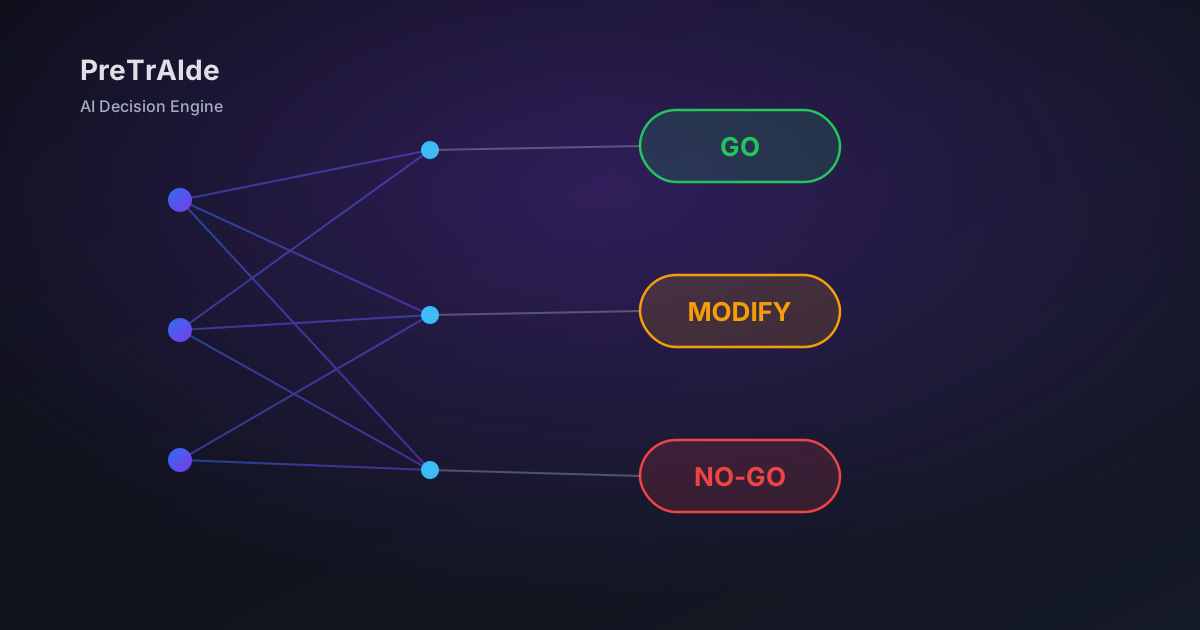
Every basket you run through PreTrAIde comes back with one of three verdicts:
- GO — the quantitative and qualitative picture supports proceeding with the basket as constructed.
- MODIFY — the underlying idea has merit, but something about sizing, timing, or composition should change first.
- NO-GO — the risk picture doesn't support proceeding as constructed, right now.
Each verdict comes with a success probability, a plain-language risk assessment, and a suggested execution strategy — so you're never left staring at a single number wondering what's behind it.
Step One: The Numbers Come First
Before any AI reasoning happens, PreTrAIde computes a deterministic quant score for every stock in your basket and for the basket as a whole — purely from data, with no language model involved yet. This includes:
- A liquidity score, estimating how easily the position could be entered or exited without excessive slippage
- A volatility score, reflecting how much the position is likely to swing day to day
- An execution score, factoring spread, venue characteristics, and volume patterns
- A concentration measure (an HHI-style calculation) that flags when a basket is more concentrated than it looks at a glance
- A Value-at-Risk estimate, expressing potential one-day loss under adverse conditions
These scores generate an initial, rules-based decision hint — a purely mechanical starting point, before any AI-generated language enters the picture.
Step Two: Context From the Real World
The engine then pulls in recent news for every ticker in your basket and current analyst ratings. This is where a stock's story gets attached to its numbers — an earnings miss, a regulatory headline, an upgrade or downgrade — so the AI isn't reasoning about a name in a vacuum.
Step Three: AI Reasoning, Anchored to the Data
Only now does the AI layer produce its per-stock and portfolio-wide trading decision. Critically, the prompts given to the model are calibration-constrained — they explicitly anchor the AI's reasoning to the quant scores computed in step one, rather than letting the model free-associate a verdict from the news alone. The result: a GO/NO-GO/MODIFY call, a success probability, a reasoning narrative you can actually read, and a suggested execution strategy (position sizing, timing considerations, order type).
Step Four: Guardrails
AI models can be confidently wrong. So the last step isn't AI at all — it's a rules-based validator that checks the AI's output against the market data and corrects it where it contradicts what the numbers show. A few concrete examples of what the guardrails enforce:
What the guardrails catch
A stock currently suspended from trading can never be recommended GO, regardless of what the AI narrative says. A GO verdict paired with a success probability below 50% gets automatically downgraded — that combination doesn't make sense and isn't allowed to reach you. All probabilities are clamped to a 5–95% range, because no model should ever claim near-certainty about market outcomes. Where there's ambiguity, the guardrails bias toward the more conservative call.
Any inconsistency the guardrails can't fully resolve is surfaced back to you rather than silently smoothed over — so you always know when a decision required correction.
Why This Architecture Matters
Most "AI trading signal" products are a single opaque model call: you send in a ticker, you get back a sentence. PreTrAIde's pipeline is intentionally layered — quant first, context second, AI reasoning third, rules-based guardrails last — because each layer catches a different kind of failure. The math catches what a language model might rationalize past. The guardrails catch what the math alone wouldn't flag as a contradiction. You get a decision that's explainable at every stage, not a black box with a confidence percentage bolted on.
See It on a Real Basket
Numbers are more convincing than descriptions. Build a basket in your dashboard, run the analysis, and read through the full reasoning behind your GO, NO-GO, or MODIFY verdict — including the quant scores that anchored it.