Every investor has felt it: that moment right before clicking "Buy," when confidence and doubt argue it out in your head. You've done the research, you like the story, the chart looks decent — but is this actually a good trade, structurally, right now, at this size? Institutional trading desks have asked that question in a formal way for decades. Retail investors, until recently, mostly haven't been able to. That's the gap pre-trade analysis closes.
What Pre-Trade Analysis Actually Means
On institutional trading desks, "pre-trade analysis" is a specific discipline: before a large order is sent to the market, quantitative analysts model how that order will behave. Will it move the price against you? Is there enough liquidity to fill it without slippage? How does this position change the risk profile of the broader book? These aren't questions about whether a stock is a good "story" — they're questions about execution quality and portfolio-level risk, answered with data, not opinion.
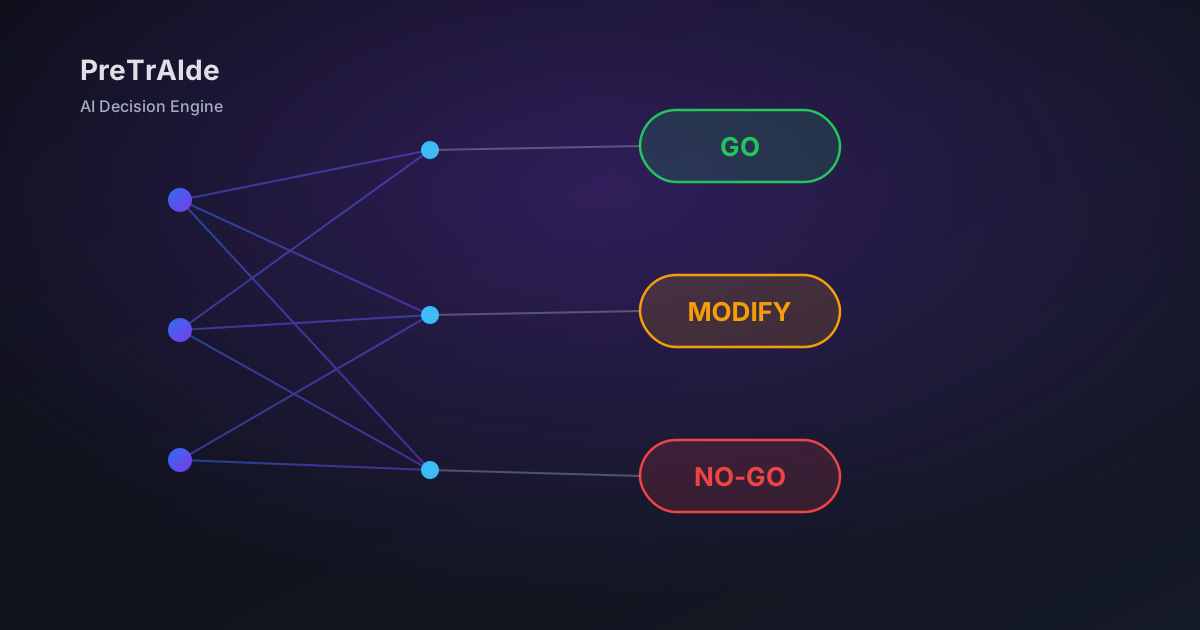
PreTrAIde brings that same discipline to a basket of stocks you're considering — buys, sells, quantities, and any execution conditions — and runs it through a full pre-trade analysis before you commit capital. You get back a structured, AI-reasoned GO / NO-GO / MODIFY decision, a success probability, a risk assessment, and a suggested execution strategy. Not a hot take. A worked analysis.
Why "I Did My Research" Often Isn't Enough
Most retail research stops at the fundamental or narrative layer: earnings, guidance, sector trends, maybe a couple of technical indicators. That's necessary, but it skips an entire category of risk that determines whether a good idea turns into a good trade:
- Liquidity risk — can the market actually absorb your order size without the price moving against you as you build or exit the position?
- Market impact — for larger positions, your own order can be a meaningful fraction of daily volume, which quietly erodes your entry or exit price.
- Concentration risk — a basket that looks diversified by number of tickers can still be dangerously concentrated by sector, currency, or market cap.
- Volatility regime — the same stock can be a very different risk at 15% annualized volatility versus 45%, even if the narrative hasn't changed at all.
These are exactly the metrics institutional pre-trade desks were built to catch — and exactly what most retail brokerage apps never show you before you tap "Confirm Order."
How PreTrAIde's Pre-Trade Analysis Works
When you submit a basket for analysis, PreTrAIde runs it through several layers before an AI ever reasons about a decision:
1. Market data enrichment
Each stock in your basket is enriched with dozens of data points — price history, volatility, sector and market-cap classification, recent news, analyst sentiment — pulling from live market data providers.
2. Quantitative pre-trade metrics
The engine computes institutional-style metrics for each position and for the basket as a whole: liquidity ratios that estimate how easily a position can be entered or exited, a market-impact estimate modeled on the kind of execution-cost research used on program-trading desks, and a risk measure that expresses potential loss in a single trading day under adverse conditions.
3. AI-reasoned decision
Only after the quantitative picture is built does the AI layer reason about your basket — cross-referencing the numbers against recent news and analyst ratings — to produce a GO, NO-GO, or MODIFY recommendation with a success probability and a suggested execution strategy. Guardrails then check the AI's output against the underlying data, so a recommendation can't casually contradict what the numbers actually show.
The goal isn't to predict the future. It's to make sure you're seeing the same risk picture a professional trading desk would see, before your capital is on the line.
Who Pre-Trade Analysis Is For
You don't need to be running a hedge fund for this to matter. It's especially useful if you:
- Build baskets of multiple stocks rather than trading one ticker at a time
- Trade in sizes large enough that liquidity and slippage are a real concern
- Want a second, dispassionate opinion before acting on conviction or a hot tip
- Are building a habit of paper-trading strategies before risking real capital
Decision support, not a crystal ball
PreTrAIde never executes trades and never guarantees an outcome — no analysis can. What it gives you is a structured, data-grounded second opinion, so the decision to trade (or not) is an informed one rather than a hopeful one.
From Analysis to Action
Once your basket has a GO / NO-GO / MODIFY verdict, the natural next step for most users isn't to immediately trade — it's to run the basket through PreTrAIde's paper-trading simulator and watch how the recommended strategy would have performed, risk-free, before deciding whether to act on it with real capital.
Try It on Your Own Basket
The fastest way to understand pre-trade analysis is to run one. Build a basket in your PreTrAIde dashboard, click Analyze, and see exactly what an institutional-style pre-trade desk would have flagged about your trade — probability, risk, and all — before you ever place it.